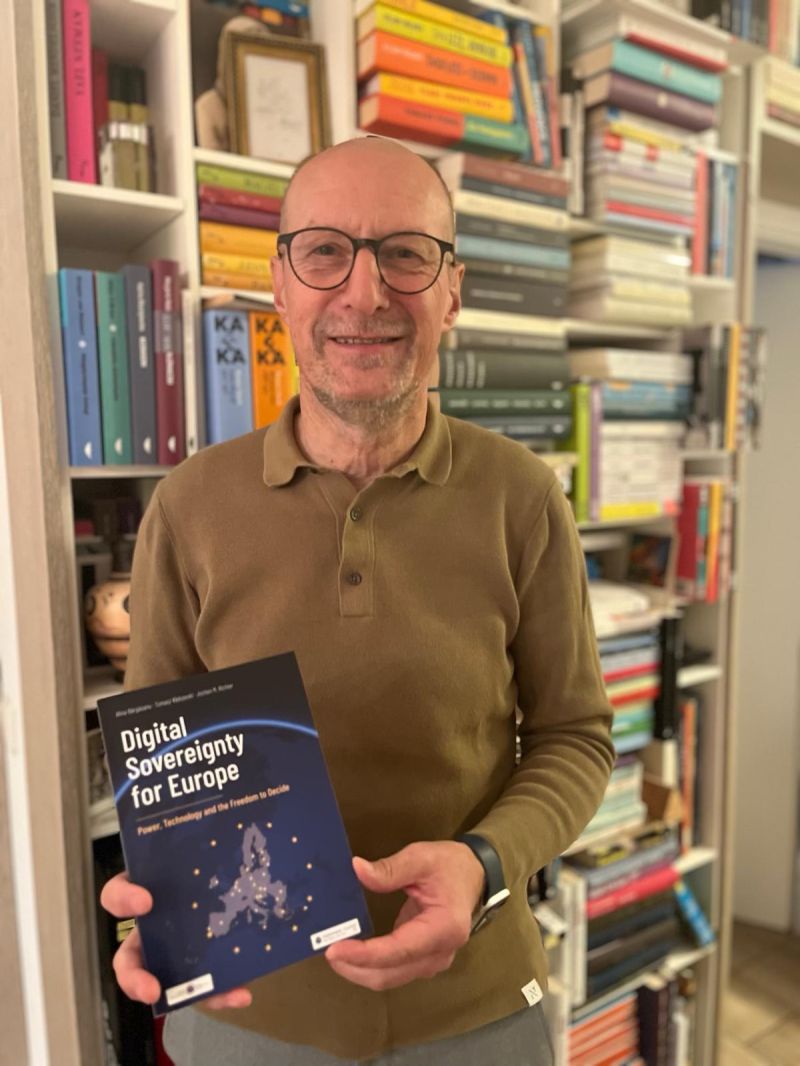
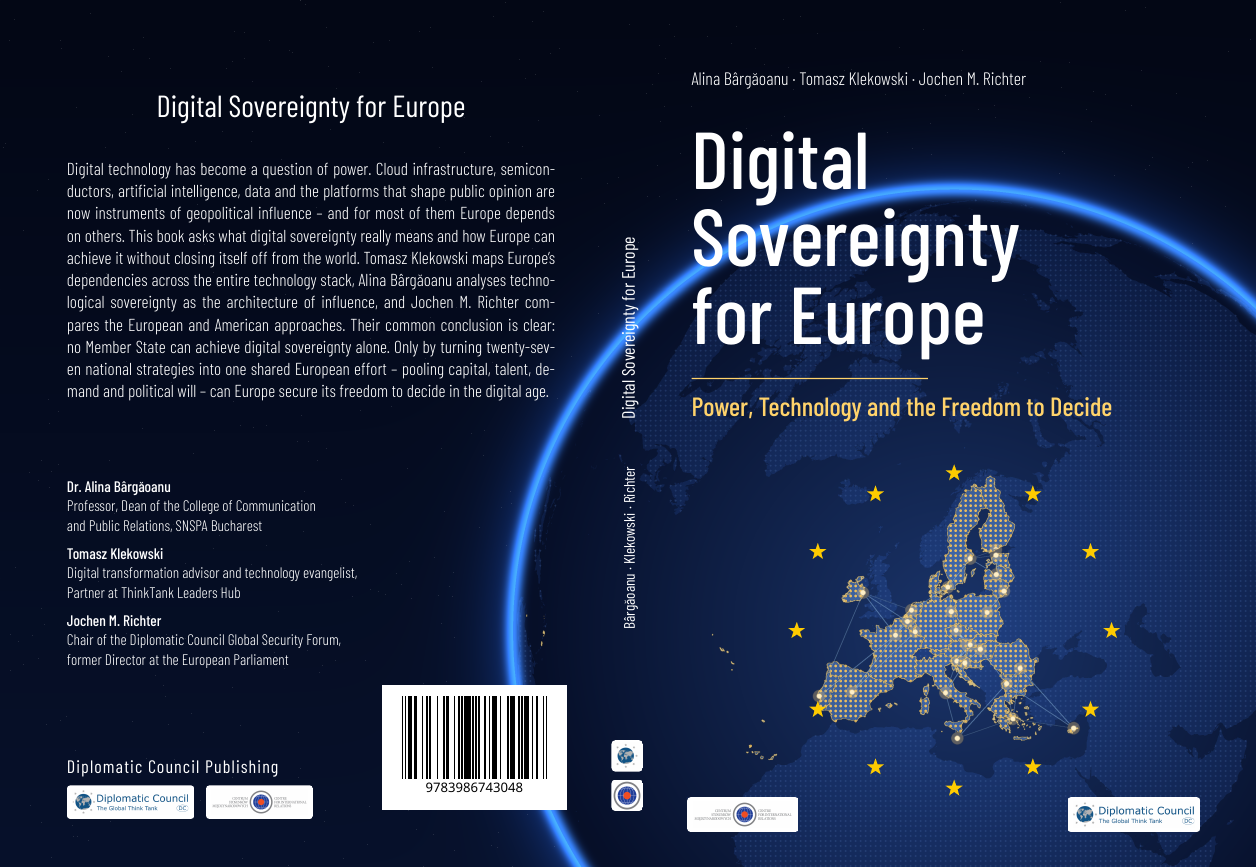
The Diplomatic Council (UN-registered) and the Centre for International Relations (Centrum Stosunków Międzynarodowych, CSM) in Warsaw have presented the first tangible result of the Memorandum of Understanding they signed in December 2025: the book “Digital Sovereignty for Europe – Power, Technology and the Freedom to Decide”, published by Diplomatic Council Publishing as a joint publication of both organisations.
The book is edited by Jochen M. Richter, Executive Member of the Diplomatic Council and Chair of its Global Security Forum, and former Director at the European Parliament. The idea for the project came from Tomasz Klekowski, Partner at ThinkTank Leaders Hub and former head of Intel’s marketing and market development across Europe, the Middle East and Africa. Dr. Alina Bârgăoanu, Dean of the College of Communication and Public Relations at SNSPA Bucharest and a member of the Diplomatic Council, contributed a central chapter. Jochen M. Richter calls it “an excellent collaboration”.
Technology as a question of power
Digital technology has become a question of power. Cloud infrastructure, semiconductors, artificial intelligence, data and the platforms that shape public opinion are now instruments of geopolitical influence – and for many of them Europe depends on others. Europe has built much of its digital life on chips designed in the United States and manufactured in Asia, on cloud platforms run by non-European hyperscalers and on AI models trained beyond its borders. The guiding question of the book is how much control Europe needs over the technologies on which its prosperity, security and democracy rest – and what it is prepared to pay for it.
A joint work of two think tanks
The book is a genuine joint effort. The Diplomatic Council’s partner, the Centre for International Relations Foundation (Centrum Stosunków Międzynarodowych, CSM/CIR) in Warsaw, was founded in 1996 and is an independent, non-governmental think tank dealing with international policy as well as Polish foreign and European policy. It aims to deepen Polish decision-makers’ knowledge of the EU and the world, to make Poland better known among opinion leaders abroad and to analyse the international situation. CSM’s work spans NATO and international security, European integration, transatlantic relations, Eastern policy, migration, climate and energy. It brings together politicians, diplomats, civil servants, business leaders, journalists and students as a forum for foreign-policy debate. The foundation is led by its President, Dr. Małgorzata Bonikowska.
With “Digital Sovereignty for Europe”, the two organisations bring together perspectives from business, academia and the European institutions – precisely the kind of cross-border cooperation the book itself calls for.
Three perspectives
Tomasz Klekowski traces Europe’s path from open collaboration to de-risking and then descends the technology stack layer by layer – semiconductors, networking and computing hardware, cloud, open-source software and the AI ecosystem – asking at each level where dependencies are most critical and what it would realistically cost to reduce them.
Dr. Alina Bârgăoanu turns to the information space. She argues that disinformation is less about false content than about algorithms, data and amplification – the “architecture of influence”. Using the EU’s regulatory response as a case study, she shows why rules cannot replace technological capacity, and why sovereignty must never become a pretext for concentrating control over public debate.
Jochen M. Richter compares Europe’s rights-based, regulation-led model with America’s blend of market liberalism and strategic intervention, and with China’s state-built digital borders – and asks whether sovereignty should mean autarky or, more realistically, strategic agency in a world of unavoidable interdependence.
From twenty-seven strategies to one
The authors deliberately preserve their differences on how far and how fast Europe should go, yet they reach a shared diagnosis: Europe can turn its talent, ideas and regulatory expertise into greater technological strength by building scale across national borders. Their proposals fit together: securing the semiconductor supply chain and building on European strengths such as ASML and RISC-V, a common yardstick for sovereign cloud, systematic support for open source, a few well-executed AI gigafactories and a genuinely European frontier model, a completed digital single market and a real Capital Markets Union. As with Airbus and the European Space Agency, coalitions of willing states pooling capital, talent and demand can build technology at world scale. Digital sovereignty, the book concludes, will come from the willingness of Europeans to act together, accept the costs and think in decades rather than electoral cycles.
Presentation in Warsaw – available now
The formal presentation of the book is planned for December in Warsaw. “Digital Sovereignty for Europe” (204 pages) is already available as a paperback (ISBN 978-3-98674-304-8) and as an e-book (ISBN 978-3-98674-305-5).
More about the book at Diplomatic Council Publishing · Order the paperback on Amazon